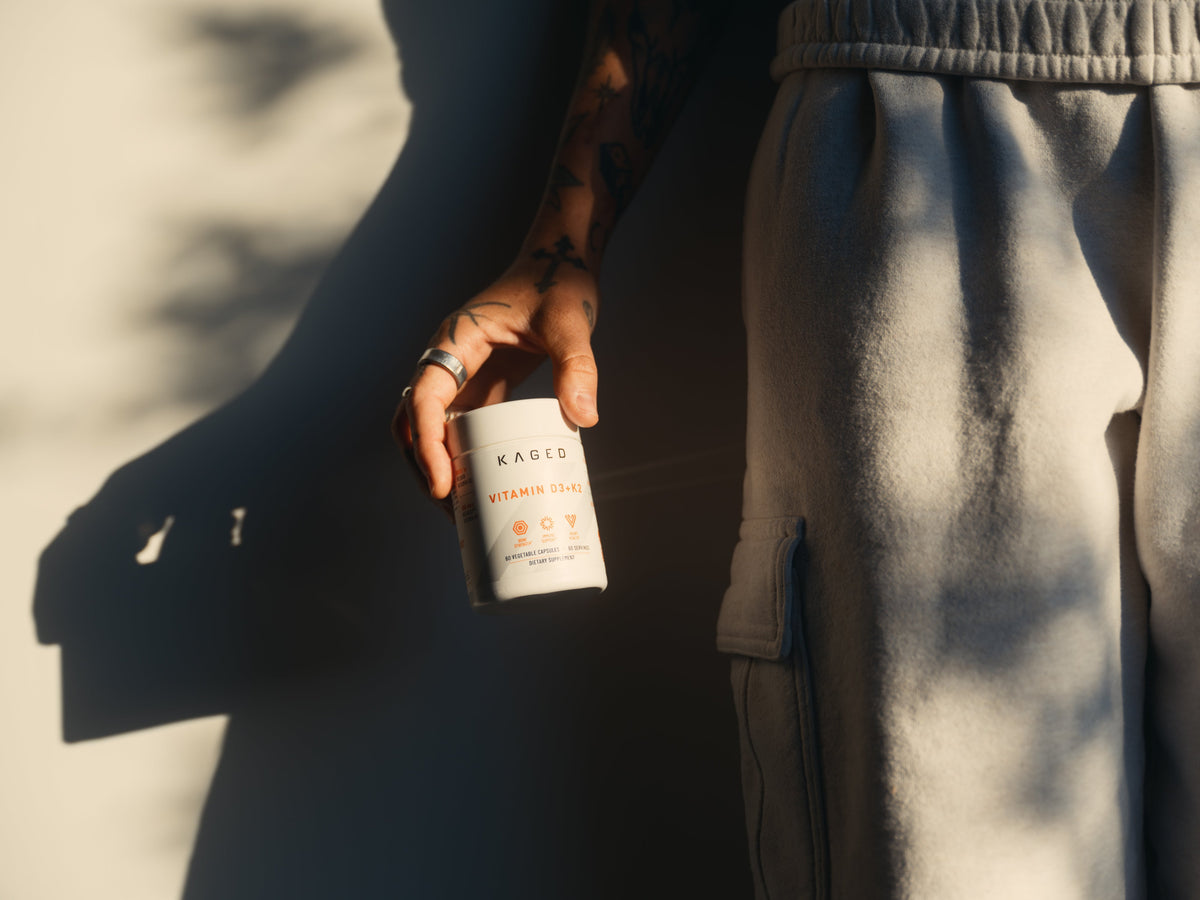
Meet Kaged Vitamin D3 + K2: The Deficiencies You Can't Feel
Vitamin D3 + K2 is the newest addition to the Kaged daily foundation lineup.
We built it around a problem most vitamin D supplements only half solve. Vitamin D raises how much calcium your body absorbs. It does not decide where that calcium goes. Vitamin K2 does.*
Take the first without the second and you have done half the job.
One Capsule, Two Nutrients
- 5,000 IU of vegan vitamin D3, sourced from plant-based lichen and not sheep's wool
- 100mcg of patented MenaQ7® vitamin K2, the high-absorption MK-7 form*
- Supports bone strength, cardiovascular health, and immune function*
- Informed Sport certified, so every batch is tested for banned substances
Why So Many People Come Up Short on Vitamins D and K
Your skin makes vitamin D from direct sunlight. That system evolved for the life spent outdoors that our ancestors had.
Most of us do not live that life anymore.
We work inside. We commute in cars. North of roughly 37 degrees latitude, a line that runs near San Francisco, the winter sun sits too low in the sky to produce meaningful vitamin D from November through March.
Food does not close the gap. The meaningful dietary sources of vitamin D are a short list: fatty fish, egg yolks, and fortified dairy.
Vitamin K2 is harder still. Its richest food source is natto, a fermented soybean dish that almost nobody in the United States eats.
The national data show the scale of it. The most recent NHANES analysis of U.S. vitamin D status, covering survey cycles through 2023, puts 15.6% of Americans at risk of inadequate vitamin D. Add the share already below the deficiency threshold and it is roughly one in five, before you separate out the people who work indoors, train indoors, or live through a northern winter.
Here is what makes it different from most nutrition problems. Low vitamin D has no reliable symptoms. It shows up on a blood panel, which is why it is worth asking for the test the next time you see your healthcare provider.
Why These Two Belong in the Same Capsule
Vitamin D3 increases how much calcium your body absorbs from food.*
Vitamin K2 activates the proteins that direct that calcium into bone tissue, and away from soft tissue like arterial walls.*
Neither one does the other's job. Absorbing more calcium is only useful if the calcium ends up where you want it. That is the argument for taking them together, and it is why they share a capsule here instead of sitting on two different shelves.*
Inside the Kaged Vitamin D3+K2 Formula
Vegan Vitamin D3 (Cholecalciferol), 5,000 IU
Most vitamin D3 supplements on pharmacy shelves start as lanolin, the grease rendered from sheep's wool. It is the cheapest input available.
At Kaged, we demand the highest quality. Ours is extracted from lichen, a plant-based source. The molecule is the same form your skin synthesizes from sunlight and the form your body converts most efficiently. The difference is the source material.
On the dose. The RDA for adults is 600 to 800 IU. That number was set as the minimum needed to avoid deficiency rather than an optimal intake, and it assumes nothing about your sun exposure, your body weight, or where you live.
We include 5,000 IU. That dose is on the higher end. The National Institutes of Health sets the tolerable upper intake level for adults at 4,000 IU per day, with signs of toxicity considered unlikely below 250mcg, or 10,000 IU. Our capsule sits between those two figures. It is not a dose to take on top of another vitamin D product.
The reason that recommendation ends at 4,000 IU is because of a specific concern about calcium. This brings us to the second half of this formula.
Why Vitamin K2 Pairs Well With Higher Doses of Vitamin D3
Vitamin D does not act on calcium by itself. It works through a set of proteins your body has to build and then switch on, and the switch is vitamin K.
Two of those proteins do the work here. Osteocalcin pulls calcium into bone. Matrix Gla protein keeps it out of arterial tissue. Both are produced in greater quantity when vitamin D is high, and both are inert until vitamin K carboxylates them.*
That relationship is the reason these two nutrients belong together at this dose. A 2017 review of the vitamin D and vitamin K literature put it directly: vitamin D promotes the production of vitamin K-dependent proteins, which require vitamin K for carboxylation in order to function properly. The same review notes that if vitamin D concentrations are constantly high, there might not be enough vitamin K available to activate them.
Raise the D3 and you raise the demand for K2. Supplying both is the formulation answer to that, and it is why we did not build a standalone 5,000 IU capsule.
MenaQ7® Vitamin K2 (MK-7), 100mcg
Two things decide whether the vitamin K2 on a label does anything at all. The form, and the shape.
The form. Vitamin K2 comes as MK-4 or MK-7. In a published bioavailability comparison in healthy women, MK-4 was not detectable in the serum of any subject at any time point, either after a single dose or after seven consecutive days. MK-7 in the same study was well absorbed, peaked at six hours, and was still measurable at 48.
A study published in Blood fills in the rest. Natto-derived MK-7 accumulated to serum concentrations seven to eight times higher than vitamin K1 during continued daily intake, held far steadier levels between doses, and produced more complete carboxylation of osteocalcin. That last part is the one that counts, because an uncarboxylated protein does nothing.*
So we were never going to use MK-4. The real question was which MK-7.
The shape. This is the part almost nobody talks about, and it is the reason we pay for MenaQ7®.
The MK-7 molecule has a long tail built on seven double bonds. In nature, that tail is straight. This is the all-trans form, and it is the one your body can use. Manufacturing can twist those bonds into a bent configuration called a cis isomer, and the bent version is considered biologically inactive. Identical on an ingredient list. Wrong shape to fit the proteins it is supposed to switch on.
It is a key and a lock. A key with a bend in it does not turn.
Which means a 100mcg label claim tells you very little by itself. What matters is how much of that 100mcg is all-trans. The U.S. Pharmacopeia standard for the raw ingredient is 96% all-trans, and finished supplements are not required to be tested for it at all.
MenaQ7® is specified at 99.8% all-trans. That is what we are paying for, and it is why our 100mcg is 100mcg of vitamin K2 your body can actually put to work.*
It is also the most studied MK-7 available. Its manufacturer counts more than 22 published human clinical trials run on this specific material, including multi-year randomized controlled trials. Most vitamin K2 on the market cites research that was run on somebody else's raw material.

What Separates This From a Basic D3 Supplement
| Kaged | Other D3 + K2 #1 | Other D3 + K2 #2 | Other D3 #3 | |
|---|---|---|---|---|
| D3 source | Lichen (vegan) | Lichen (vegan) | Lanolin | Lanolin |
| D3 dose | 5,000 IU | 5,000 IU | 1,000 IU | 2,000 IU |
| K2 form | MenaQ7® patented MK-7 | Unbranded MK-7 | MK-4 | None |
| K2 dose | 100mcg | 100mcg | 45mcg | None |
| All-trans purity | 99.8% specified | Not disclosed | Not disclosed | — |
| Informed Sport certified | Yes | No | No | No |
Three rows in that chart do most of the work.
The D3 source. Lichen-derived cholecalciferol makes the product suitable for a plant-based diet without dropping to the D2 form, which your body converts less efficiently.
The K2 form, and its purity. A vitamin D product with no K2 leaves the placement half of the job undone. A product built on MK-4 is running a form that does not reliably reach serum at supplemental doses. Unbranded MK-7 is much closer, but it rarely publishes an all-trans figure, and that figure is what determines how much of the dose your body can use.*
The testing. Informed Sport certification means every batch is tested for banned substances before it ships. That is standard in sports nutrition and uncommon in the general vitamin aisle.
What to Expect, and When
Week 1 to 2. Serum vitamin D begins climbing from your baseline.
Week 4 to 8. Levels approach steady state on consistent daily intake. This is the point where a blood panel would show a meaningful difference.
Ongoing. D3 and K2 are maintenance nutrients. Their value comes from daily intake over months and years, not from any single dose.*
Here is the honest version. You will not feel this one. There is no pump, no rush of energy, no moment where it kicks in. It is a foundational supplement, and the way you verify it is working is a blood test.
How to Take It
One capsule daily, with a meal that contains fat. D3 and K2 are both fat-soluble, which means absorption improves considerably when there is fat in your stomach to carry them. Eggs, avocado, olive oil, peanut butter, or a serving of Kaged Omega-3 all do the job.
Morning is the simplest time, because it attaches to a meal you already eat. Evening works equally well. Consistency matters more than timing, so pick the slot you will actually keep.
If you already take Kaged Multivitamin, do not stack this on top of it. The Multivitamin already contains whole-food sourced vitamins D and K.
Who It's For. Who It's Not For.
Vitamin D3 + K2 is a good fit for:
- People who work indoors, which is most people.
- Anyone training hard year-round, and especially anyone training indoors through the winter.
- Anyone eating plant-based, who has been shut out of most D3 products by the lanolin problem.
- Athletes subject to testing, since every batch is Informed Sport certified.
It is not the right product if you already take a multivitamin containing D and K. Doubling up on vitamin D is the most common way people end up higher than they intended.
It is also not the right product if you take warfarin or another vitamin K antagonist. Vitamin K2 at this dose can interfere with how those medications work. Talk to your healthcare provider before starting, and do not change an anticoagulant regimen on your own.
And it is not a substitute for knowing your numbers. A serum 25(OH)D test from your healthcare provider is the only way to know where you actually stand. If your levels are already in good shape, a lower-dose vitamin D or none at all may serve you better than this one.
Common Questions
Is vegan D3 as effective as D3 from sheep's wool?
Yes. Both are cholecalciferol, the same molecule your skin makes from sunlight. The difference is the source material, not the nutrient. Ours is extracted from a natural oil present in lichen.
Why do D3 and K2 need to be taken together?
D3 increases how much calcium your body absorbs from food. K2 activates the proteins that direct that calcium into bone tissue rather than soft tissue. D3 handles uptake. K2 handles placement.*
Is 5,000 IU of vitamin D too much?
It depends on where you are starting. The RDA is 600 to 800 IU, the National Institutes of Health sets the tolerable upper intake level for adults at 4,000 IU per day, and signs of toxicity are considered unlikely below 10,000 IU. Our capsule sits above the upper intake level and well below the toxicity threshold, which is a common position for a corrective rather than maintenance dose. Do not take it alongside another vitamin D product, and ask your physician for a 25(OH)D test rather than guessing.
What is MenaQ7® and why does it matter?
MenaQ7® is a patented vitamin K2 as MK-7, produced through natural fermentation and specified at 99.8% all-trans, which is the biologically active shape of the molecule. We use it for two reasons. MK-7 is the form that reaches circulation and stays there, reaching serum concentrations seven to eight times higher than vitamin K1 during continued intake and carboxylating osteocalcin more completely. And the all-trans specification means nearly the whole 100mcg is usable rather than an unknown fraction of it.*
What does "all-trans" MK-7 mean, and why does it matter?
The MK-7 molecule has a long tail of seven double bonds. In its natural, all-trans state that tail is straight, which is the shape that fits the proteins vitamin K is meant to activate. Production can bend those bonds into a cis isomer, which is considered biologically inactive. Both forms count toward the microgram total on a label, so two products can each say 100mcg while delivering very different amounts of usable vitamin K2. The U.S. Pharmacopeia standard for the raw ingredient is 96% all-trans, finished supplements are not required to be tested for it, and MenaQ7® is specified at 99.8%.
What is the difference between MK-4 and MK-7?
Chain length, and it changes everything downstream. MK-4 clears the bloodstream within hours. In a published comparison in healthy women, supplemental MK-4 was not detectable in serum at any time point, while MK-7 was well absorbed and still measurable 48 hours after a dose. MK-7 is the form that stays in circulation between servings.*
Can I take this if I'm on a blood thinner?
Not without talking to your physician first. Vitamin K2 at 50mcg per day and above can interfere with warfarin and other vitamin K antagonists. This capsule contains 100mcg.
Do I need to take it with food?
Yes. D3 and K2 are fat-soluble. Absorption improves considerably with a meal containing fat, and taking them on an empty stomach reduces how much your body takes up.
Morning or night?
Either. Take it with whichever meal contains fat and is easiest to remember. Consistency matters more than timing.
How do I know if I'm low on vitamin D?
You usually cannot tell, which is the reason it goes unnoticed. A serum 25(OH)D blood test from your physician is the only way to know your level.
How long does it take to work?
Serum vitamin D levels typically rise over four to eight weeks of consistent daily intake before reaching a steady state. This is not a supplement you feel. It is one you take daily and verify with bloodwork.
Can I take it alongside other Kaged products?
It stacks cleanly with the rest of the line, and Kaged Omega-3 is the natural pairing since the fatty acids support absorption of both fat-soluble vitamins. The one exception is Kaged Multivitamin, which already contains vitamins D and K. Do not run both.