7 Tips to Avoid a Pre-Workout Crash
The crash that hits an hour after your pre-workout is not the price of admission. It is a sign that something in your formula, or in how you take it, is working against you. Fix the inputs and you can limit the pre-workout crash.
A pre-workout crash comes down to a handful of well-understood mechanisms. Once you know what they are, you can choose a smarter formula and a few better habits. This guide covers why the crash happens, what the research says about the ingredients that prevent it, and what to look for in a pre-workout so that you're not crashing halfway through your intense training.
What Is a Pre-Workout Crash
A pre-workout crash is the sharp drop in energy, mood, and focus that follows the peak of a pre-workout supplement. It feels like one event. It is actually several biological processes overlapping at once.
The common symptoms:
- Mental fatigue and brain fog. Trouble focusing, mentally slow.
- Physical lethargy. Heavy legs, low drive to move.
- Irritability or low mood. A post-workout funk unrelated to how you trained.
- Headaches. Often dehydration stacked on top of stimulant use.
- Jitters that fall into fatigue. The wired-then-flat cycle.
Knowing where these come from is the first step to preventing them.
Why Pre-Workout Crashes Happen
Adenosine Rebound
This is the main driver behind almost every caffeine crash. It matters because caffeine sits at the center of nearly every pre-workout on the market.
Caffeine works by blocking adenosine receptors in the brain. Adenosine is a neurotransmitter that builds up throughout the day and signals your brain toward sleep. Caffeine does not remove adenosine. It takes the seat in the receptor and blocks the signal.
While caffeine holds those receptors, adenosine keeps accumulating behind it. When caffeine clears your system, all of that adenosine arrives at once. The result is a sudden, heavy pull toward sleep. That is the crash.
Research on caffeine and sleep-wake regulation points to adenosine rebound as the dominant mechanism behind post-caffeine fatigue. The severity tracks with how much caffeine you took and how much adenosine has built up. The higher the dose, the harder the crash. This is why mega-dosed pre-workouts tend to produce the worst ones. A bigger blockade builds a bigger debt.
The Epinephrine Spike and Drop
Caffeine and other stimulants push your adrenal glands to release epinephrine, or adrenaline. That surge is part of the sharp, locked-in feeling you want when walking into a session.
Epinephrine has a short half-life. Once your body burns through the surge, levels fall, and your energy, mood, and drive fall with them. A fast drop feels like a wall instead of a gradual return.
This is why the source of your caffeine matters as much as the dose. A caffeine source that produces a more measured epinephrine response gives you a smoother arc and a softer landing.
Blood Sugar Instability
Many pre-workouts, especially older formulas, are loaded with sugar and simple carbohydrates. Caffeine on its own also affects insulin sensitivity and prompts the liver to release glucose into the blood.
You get a fast blood sugar spike followed by an equally fast drop. That glycemic crash lands on top of the adenosine rebound. Take a sugar-heavy pre-workout on an empty stomach and you set up a double crash.
A formula built on clean, researched ingredients instead of filler sugar removes one of the largest crash drivers outright.
1) Choose Higher Quality Caffeine
Not all caffeine behaves the same, and this matters more than most lifters realize.
Synthetic caffeine and natural plant caffeine are the same molecule. What differs is how they are delivered and what they arrive with. Those differences change how you feel.
Synthetic Caffeine
Pure synthetic caffeine absorbs fast and spikes blood caffeine sharply. It hits hard, which is useful for an initial surge. The drop tends to be just as abrupt. Nothing else in the dose modulates the effect, so jitters and a harder crash are more likely.
Natural, Plant-Based Caffeine
Natural caffeine arrives with a matrix of companion compounds. Theobromine, chlorogenic acids, catechins, and L-theanine all modulate how caffeine absorbs and acts. The result is a more gradual energy curve with less of the spike-and-crash pattern.
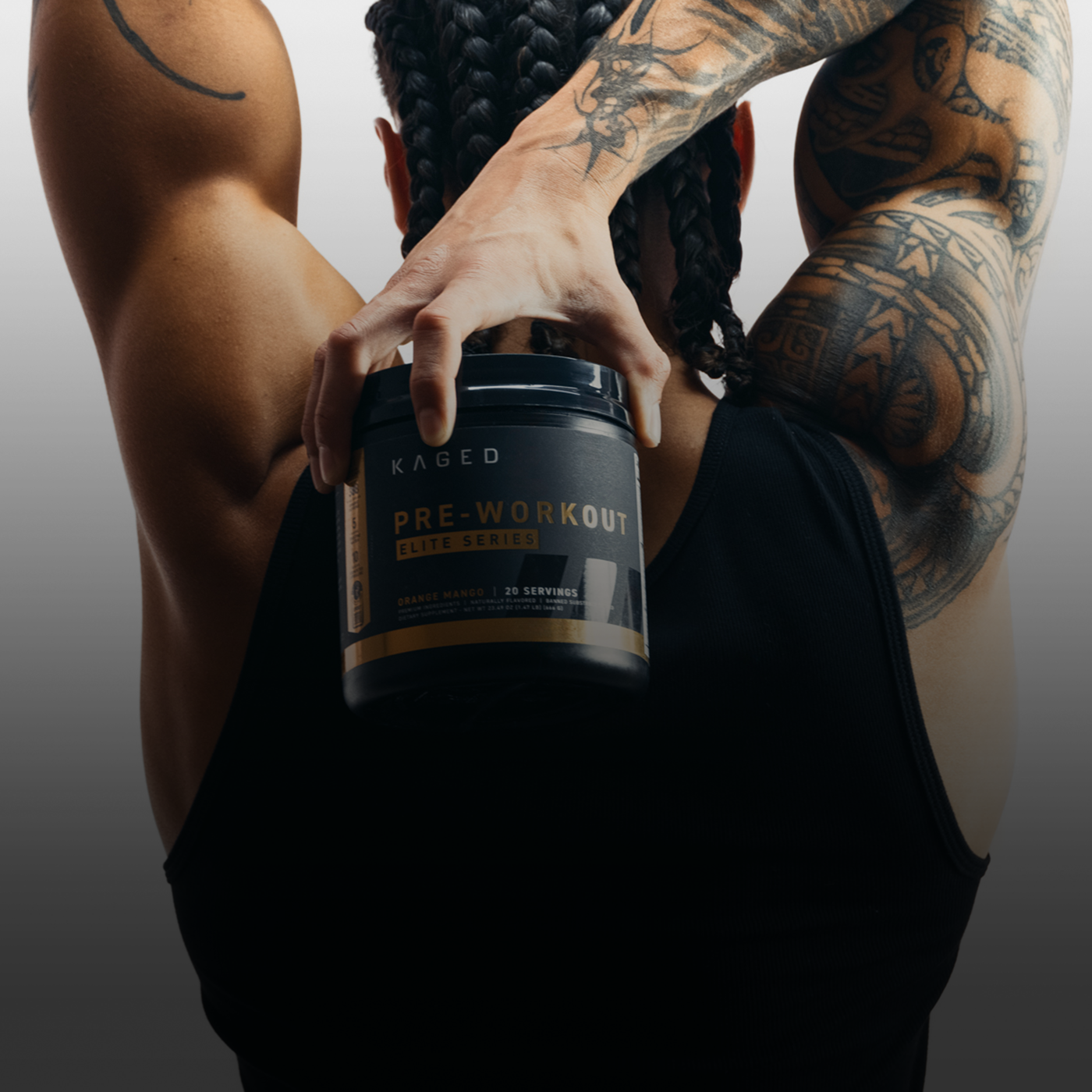
AmaTea®, the Caffeine Source in Kaged Pre-Workout Elite
AmaTea® Guayusa Leaf Extract, opens in a new tab is a patented natural caffeine source from the guayusa plant (Ilex guayusa), a holly native to the Amazon. It delivers a smooth energy profile, and there is good human data behind it.
In a 2022 study on gamers, participants took AmaTea®, synthetic caffeine, or a placebo. The two caffeine groups each received 270 mg, a dose high enough to produce noticeable jitters in many people. The synthetic group reported more jitters. The AmaTea® group reported no increase.
A separate pharmacokinetic study compared the two head to head. AmaTea® produced a significantly lower epinephrine response, +0.5 μg/gCr versus +2.78 μg/gCr for synthetic caffeine (P = 0.04). Both delivered the same caffeine to the bloodstream. AmaTea® did it without the same adrenal surge.
That lower epinephrine response is the point. A smaller adrenal spike means a smaller adrenal drop. You get the energy without the stress response that drags you down once it fades.

2) Look for Ingredients to Support Absorption
Most people never think about absorption when they pick a pre-workout. They should. You can own the best formula on the market, but if the ingredients absorb unevenly, you lose performance and you get an inconsistent energy experience.
Uneven, rushed absorption produces a sharper peak and a steeper drop. More complete, consistent absorption produces a steadier curve and a gentler comedown.
MAX Catalyst™
MAX Catalyst™, opens in a new tab is a patented Piper nigrum (black pepper) fruit extract. It is a bioavailability enhancer found in both Kaged Pre-Workout Elite and Kaged Pre-Workout Max.
You may know piperine, the active compound in black pepper used in Ayurveda and Traditional Chinese Medicine to support the absorption of other compounds. Standard piperine boosts the bioavailability of ingredients like curcumin, CoQ10, and resveratrol.
The catch is speed. Ordinary piperine works slowly. Caffeine and L-citrulline work fast. Standard piperine cannot keep pace with fast-acting pre-workout compounds.
MAX Catalyst™ closes that gap. Patented technology lets piperine act on fast-absorbing ingredients, the exact compounds that determine your pre-workout experience. In clinical testing, MAXCatalyst™ improved the absorption of key ingredients:
- Caffeine: increased perceived duration of energy, with less jitters and crash.*
- L-Citrulline: 64% improvement in plasma amino acid concentration.*
- Beta-Alanine: 116.23% improvement in plasma amino acid concentration.*
- Creatine: 40.15% improvement in plasma concentration.*
For crash prevention, the caffeine result is the one that counts. Increased perceived duration of energy, with less jitters and crash, means MAX Catalyst™ is not just helping you absorb more caffeine. It helps your body experience caffeine more smoothly and for longer, which flattens the sharp peak-and-trough that produces a crash.
Pair MAX Catalyst™ with a natural caffeine source like AmaTea® and you address two of the biggest crash drivers at once. The quality of the caffeine, and the efficiency of its delivery.
3. Match the Dose to Your Body Weight and Sensitivity
Research puts the performance dose of caffeine at 3 to 6 mg per kilogram of body weight. For a 175 lb (80 kg) lifter, that is roughly 240 to 480 mg. Individual sensitivity varies widely.
Genetics drive a lot of it. The CYP1A2 gene controls how fast your liver clears caffeine. Fast metabolizers process it in about two hours. Slow metabolizers can take eight or more. If you crash hard and often, your metabolism may run slow, which means a lower dose serves you better no matter what the label says. Start low and dial it in. More is rarely better here.
4. Time It Right
Take your pre-workout 20 to 30 minutes before training for a standard formula. Caffeine peaks in the blood around 30 to 60 minutes after you take it, so you want the curve to crest during your session, not before it.
One note on citrulline. L-citrulline takes up to 60 minutes to convert to arginine and then to nitric oxide. If your formula leans heavy on citrulline, take it a full hour out for the best pump and endurance benefit.
5. Do Not Train on Empty
An empty stomach speeds absorption, opens in a new tab, which sounds good but speeds the crash too. It also worsens the blood sugar swing.
Eat a light, balanced meal 30 to 60 minutes before you train. Aim for quality carbohydrates and moderate protein. Skip heavy fat and fiber right before, since both slow digestion and can blunt absorption.
6. Hydrate More Than You Think
Under-hydration amplifies every symptom of a crash.
Start hydrating at least four hours out, around 5 to 7 mL per kg of body weight. Mix your pre-workout with extra water. That also slows absorption slightly and smooths the curve.
7. Cycle Your Use
With chronic caffeine use, your brain adds adenosine receptors to offset the constant blockade. That is called upregulation. More receptors mean a stronger adenosine signal when caffeine clears, which deepens the crash and builds tolerance.
Cycle off for one to two weeks every four to six weeks of regular use. Receptor density normalizes, your sensitivity resets, and lower doses work again when you come back.
How Kaged Pre-Workouts Outsmart The Crash Out
The crash is not a rite of passage. It is an engineering problem, and it has an engineering solution.
Both Kaged Pre-Workout Elite and Pre-Workout Max, our highest caffeine formulas, include MAXCatalyst™, the precision piperine system that improves absorption of fast-acting ingredients, caffeine included.

That means more consistent absorption, a steadier curve, and the clinical result behind it. Increased perceived energy duration, with less jitters and crash.*
Pre-Workout Elite goes further. It uses AmaTea® Guayusa Leaf Extract as its primary caffeine source, a natural caffeine with a clinically lower epinephrine response and no rise in jitters against synthetic caffeine at the same dose. Same caffeine, smoother arc, gentler landing.
Together they form a two-layer approach. Source the caffeine from a natural matrix that modulates its effects, then optimize how that caffeine absorbs for consistency and duration.
What to Look for in a Pre-Workout That Will Not Crash You
A quick checklist for reading a label with crash prevention in mind:
- Natural caffeine sources. Guayusa, green tea extract, or other plant sources over synthetic caffeine alone.
- Bioavailability enhancers. MAXCatalyst™, Bioperine®, or another piperine-based ingredient that supports consistent absorption.
- L-theanine. Ideally near a 2:1 ratio with caffeine to smooth the curve and lower the stress response.
- No filler sugar. Skip formulas leaning on added sugar or cheap carbohydrates that feed blood sugar swings.
- Transparent labeling. You should see the exact dose of every ingredient. Proprietary blends hide dose, which hides risk.
- Effectively dosed actives. L-citrulline, beta-alanine, and creatine belong at researched doses.
The crash happens for clear reasons. Adenosine rebound, the epinephrine drop, blood sugar swings, and uneven absorption. None of them are inevitable. Pick the formula and the habits that account for what goes up, and the descent gets gradual instead of brutal. See how Kaged builds pre-workout energy that lasts.
*These statements have not been evaluated by the Food and Drug Administration. This product is not intended to diagnose, treat, cure, or prevent any disease.